

Cross roller bearings are high-performance precision components designed for demanding industrial applications, combining compactness, rigidity, and multi-directional load capacity in a single unit.
Their core design features cylindrical rollers arranged perpendicularly (90°) between split inner/outer rings, with separators preventing friction between rollers. This layout enables the bearing to handle radial, axial, and moment loads simultaneously—eliminating the need for multiple traditional bearings.
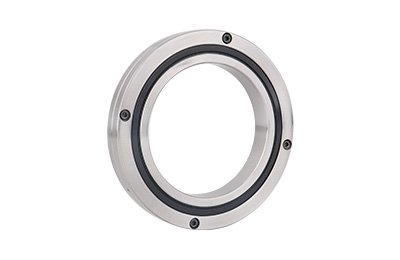
Compared to standard bearings, they deliver 3–4x higher rigidity, making them ideal for high-precision equipment like robotic joints, CNC machine tool turntables, and semiconductor lithography stages.
Key advantages include ultra-tight rotational accuracy (down to 0.001mm runout) and space efficiency: their slim profile reduces equipment size while maintaining heavy-load capability (up to thousands of kN in moment resistance). They also support low-friction, high-speed operation, with nylon separators minimizing inertia and startup torque for responsive motion control.
Common applications span industries:
Robotics: Supports precise, repeatable movements in articulating arms (±0.02mm positioning accuracy).
Machine Tools: Ensures stability in 5-axis machining turntables under cutting forces.
Medical Devices: Powers smooth rotation in surgical equipment and diagnostic scanners.
Aerospace: Handles vibration and tilt loads in satellite antenna mounts.
Installation requires precision: split rings simplify assembly, but uniform bolt torquing (in diagonal stages) and clean, debris-free mating surfaces are critical to avoid roller misalignment. Lubrication with low-torque grease (1/3–1/2 fill volume) preserves performance, while sealed variants extend service life in dusty or moist environments.
As manufacturing shifts toward miniaturization and high precision, cross roller bearings remain essential for balancing compact design, load capacity, and accuracy in next-generation machinery.