

In today’s high‑precision manufacturing and automation sectors, rotary cross roller bearings have become a core component for engineers and designers seeking compactness, rigidity, and rotational accuracy. Unlike conventional ball bearings or tapered roller bearings, these specialized rotary bearings deliver unmatched performance in confined spaces while handling complex multi‑directional loads. This guide breaks down their structure, key advantages, real‑world applications, selection tips, and maintenance best practices to help you make informed decisions for your machinery.
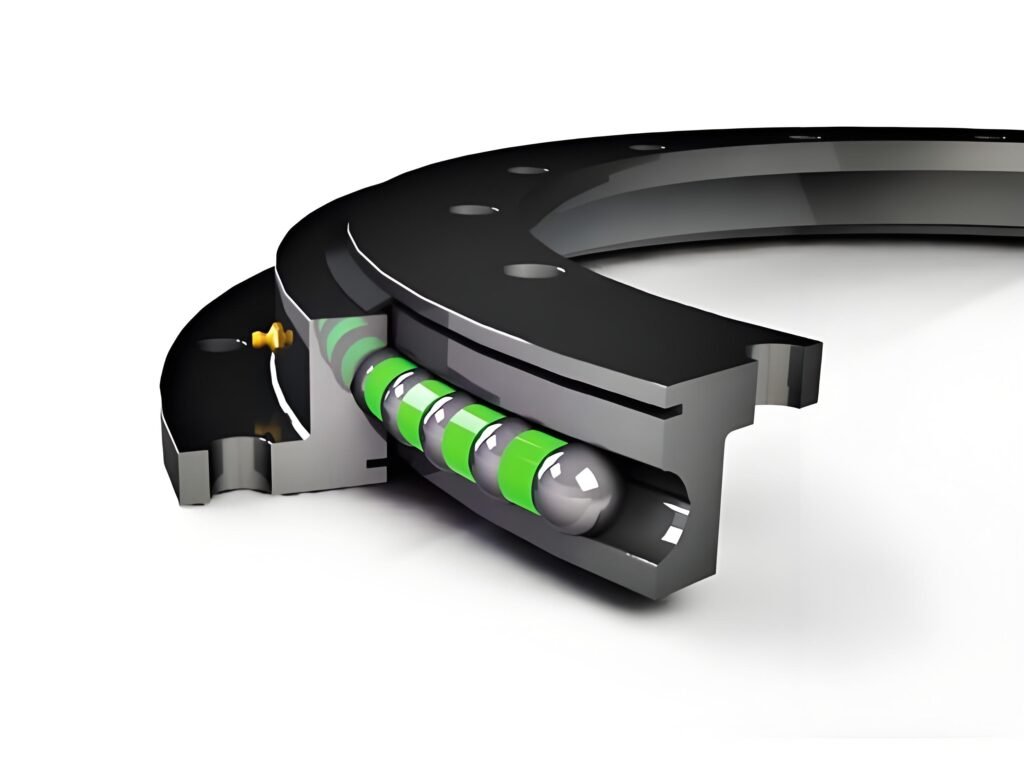
What Is a Rotary Cross Roller Bearing?
A rotary cross roller bearing is a precision slewing bearing with cylindrical rollers arranged perpendicularly in a 90° V‑shaped raceway between inner and outer rings. Separators or cages keep rollers evenly spaced, preventing skew and friction. This single‑row cross configuration lets one bearing simultaneously support radial loads, axial loads, and moment loads—a capability that normally requires multiple standard bearings.
Designed for smooth, controlled rotation, these bearings excel in indexing tables, robot joints, and rotary platforms where minimal deflection and high accuracy are non‑negotiable.
Core Structural & Performance Advantages
- Exceptional Rigidity & Precision
Line contact between rollers and raceways boosts rigidity 3–4 times vs. standard ball bearings. Preload installation eliminates internal clearance, delivering micron‑level rotational accuracy ideal for P4–P2 high‑precision applications. - Compact, Space‑Saving Design
Their slim profile and integrated load capacity drastically reduce assembly size. Perfect for robots, medical devices, and compact automation equipment where space is limited. - Multi‑Directional Load Capacity
A single bearing handles radial, axial, and overturning moments, simplifying machinery structure, cutting parts count, and lowering overall weight. - Smooth, Low‑Friction Rotation
Optimized roller alignment and separators minimize friction torque for quiet, stable motion, less heat buildup, and extended service life. - Easy Installation & Adaptability
Many models come with mounting holes for direct flange mounting, no extra fixtures needed. Split inner/outer ring designs simplify fitting and preload adjustment.
Key Industrial Applications
Rotary cross roller bearings power precision motion across industries:
Industrial Robots: Joints and rotary actuators for stable, accurate movement.
CNC Machine Tools: Rotary tables, indexing tables, and turntables for consistent machining precision.
Precision Instruments: Coordinate measuring machines (CMM), optical devices, and inspection stages.
Medical Devices: Surgical robots and diagnostic equipment requiring sterile, quiet precision.
Semiconductor & Electronics: Wafer handling and IC manufacturing tools.
Aerospace & Radar: Antenna pedestals and tracking systems for stable rotation.
Automation & Logistics: AGV steering and rotary positioning units.
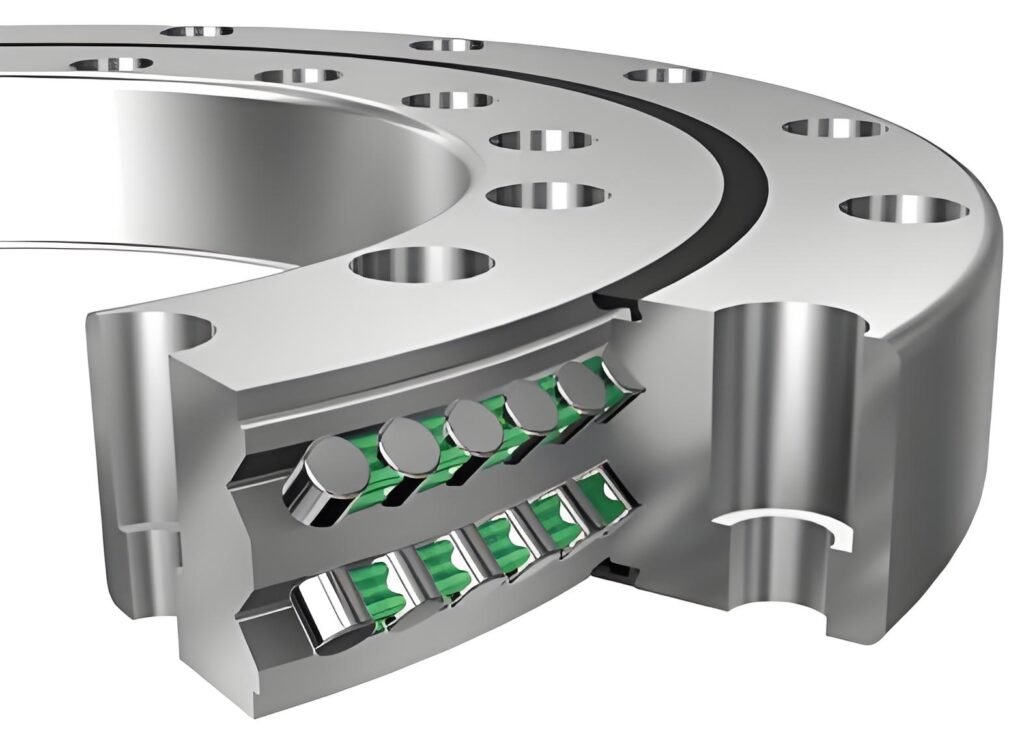
How to Select the Right Rotary Cross Roller Bearing
Load Profile: Calculate radial, axial, and moment loads to choose adequate capacity.
Accuracy Class: Pick P4/P2 for ultra‑precision; P5 for standard automation.
Size & Mounting: Match inner/outer diameter, height, and mounting holes to your design.
Structure Type:
Integral ring: High rigidity, good for stable rotation.
Split ring: Easier installation and preload tuning.
Environment: Select sealed, corrosion‑resistant, or high‑temp variants for harsh settings.
Retainer Type: Nylon for low noise; metal for high temperatures.
Installation & Maintenance Tips
Mounting: Fix evenly with bolts; avoid distortion from uneven force.
Preload: Set proper preload to boost rigidity and accuracy; follow manufacturer specs.
Lubrication: Use lithium grease or extreme‑pressure oil; follow interval guidelines.
Seal Care: Keep seals intact to block dust and moisture.
Inspection: Regularly check noise, vibration, and temperature; address irregularities early.
Conclusion
Rotary cross roller bearings are irreplaceable in today’s precision machinery. Their compact build, high rigidity, multi‑load capacity, and micron precision make them the top choice for robotics, CNC tools, medical devices, and automation. Choosing the right model and following proper installation/maintenance ensures long, reliable service and cuts downtime.
Whether upgrading equipment or designing new machinery, cross roller bearings bring consistent precision and efficiency to your rotary motion systems.
SEO Keywords (Naturally Integrated)
rotary cross roller bearing, crossed roller bearing, precision rotary bearing, high rigidity cross roller bearing, compact slewing bearing, robot joint bearing, CNC rotary table bearing