

In the world of mechanical engineering, where every millimeter and gram counts, thin section bearings stand out as a game-changing solution. Also known as ultra-thin wall bearings or slimline bearings, these components redefine what’s possible in compact design without compromising on performance. Unlike conventional bearings with bulky ring structures, thin section bearings feature uniformly thin inner and outer rings, typically with a height-to-width ratio of ≤ 0.25, making them indispensable for applications where space and weight are critical constraints.
Understanding the Core Types of Thin Section Bearings
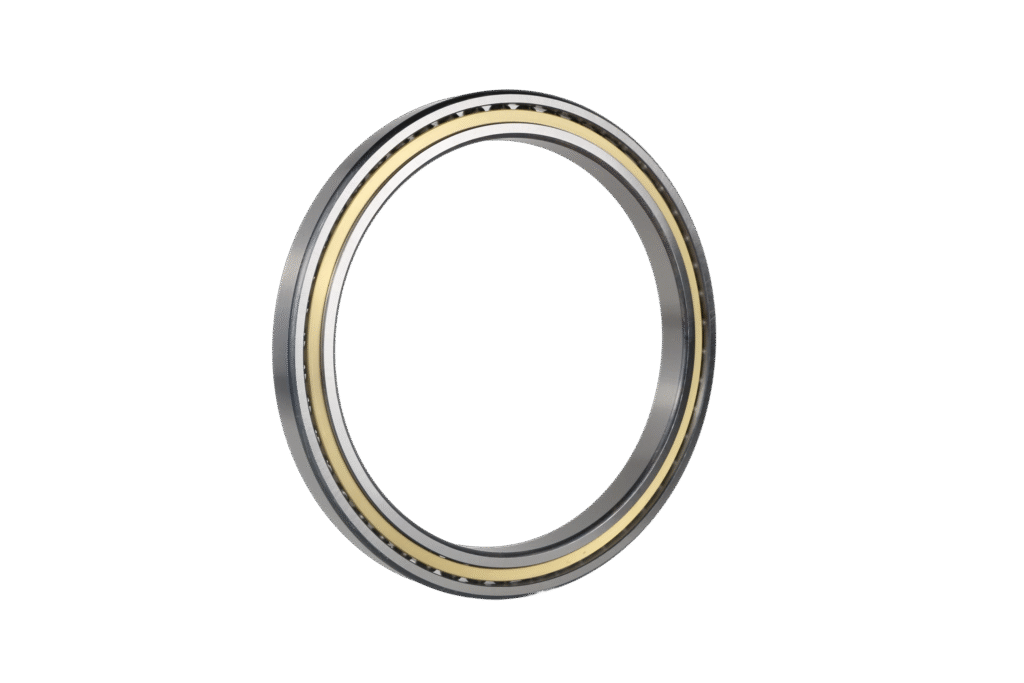
Thin section bearings are not a one-size-fits-all solution—they come in several specialized types, each tailored to specific load and precision requirements. The most common variants include:
Thin-Section Deep Groove Ball Bearings: Designed to handle both radial and light axial loads, these bearings are ideal for general-purpose compact applications. Their extra-deep ball grooves ensure smooth operation and reliable load distribution, making them a go-to choice for small-scale automation equipment.
Thin-Section Angular Contact Ball Bearings: Optimized for combined radial and axial loads, these bearings excel in high-precision scenarios like machine tool spindles and optical platforms. They are often supplied in matched sets (tandem, back-to-back, or face-to-face arrangements) to enhance rigidity and alignment control.
Thin-Section Four-Point Contact Ball Bearings: A versatile option that supports bidirectional axial forces and moment loads with a single bearing, eliminating the need for paired components. This design saves space in applications such as robotic joints and satellite antennas, where complexity must be minimized.
Thin-Section Crossed Roller Bearings: Engineered for maximum rigidity, these bearings use crossed cylindrical rollers to deliver exceptional precision in rotation. They are the top choice for precision metrology devices and surgical robots, where even minimal deflection can compromise performance.
Key Advantages Over Conventional Bearings
The unique design of thin section bearings translates to tangible benefits that set them apart from standard bearings. Weight reduction is one of the most significant—they are typically 20% to 40% lighter than conventional bearings of the same diameter, a critical factor in aerospace and portable equipment.
Space efficiency is another major advantage. Their slim profile allows engineers to design more compact machinery, opening up possibilities in medical devices like CT scanners and semiconductor wafer handling arms, where internal space is extremely limited. Despite their thin walls, these bearings maintain high precision (often reaching P4/P5 accuracy grades) and rigidity, outperforming standard bearings in applications that demand both compactness and precision.
From a total cost perspective, thin section bearings also offer value. While their unit cost may be higher, their space-saving design reduces the need for additional support structures, lowering overall system costs. This makes them a cost-effective choice for high-performance systems.
Critical Applications Across Industries
Thin section bearings have become integral to industries that prioritize precision, compactness, and lightweight design. In the aerospace sector, they are used in satellite antennas and gyroscopes, where every gram of weight affects fuel efficiency and payload capacity. The medical industry relies on them for surgical robots and diagnostic equipment, where high precision and low friction are essential to patient safety.
In industrial robotics, thin section bearings enable the smooth operation of joint and rotary units, supporting the flexibility and agility of collaborative robots. The semiconductor industry uses them in cleanroom-compatible wafer handling systems, where their precision ensures consistent performance in microfabrication processes. Even in precision instruments like optical platforms and metrology devices, these bearings deliver the stability needed for accurate measurements.
Key Considerations for Selection and Installation
Choosing the right thin section bearing requires careful attention to application requirements. Material selection is critical—high-carbon chromium steel (e.g., GCr15) is standard for general use, while stainless steel (e.g., G95Cr18) or ceramic is preferred for corrosive environments. Surface treatments like silver plating or phosphating can further enhance performance in harsh conditions.
Lubrication is another vital factor. Thin walls dissipate heat poorly, so low-volatility greases (such as PFPE) or oil mist lubrication are recommended for high-speed applications. Installation must be precise to avoid damaging the thin rings—interference fits should be controlled (H7/G6 tolerance is ideal), and special tools may be needed to prevent distortion.
For applications with shock loads, reinforced cages (phenolic resin or monolithic metal) are essential. In vacuum environments, non-outgassing lubricants are required to avoid contamination, while corrosive settings may benefit from nickel plating or other protective coatings.
The Future of Thin Section Bearings
As industries continue to push toward smaller, more efficient machinery, the demand for thin section bearings will only grow. Advancements in materials and manufacturing processes are expanding their capabilities—from higher load capacities to improved corrosion resistance—making them suitable for even more challenging applications. Whether in aerospace, medical technology, or robotics, thin section bearings will remain a cornerstone of precision engineering, proving that bigger isn’t always better when it comes to mechanical performance.